Legendary
Jean-Jacques Rousseau
Wrote The Social Contract, Émile and the Confessions, and argued that law is only legitimate when it follows the people's general will.
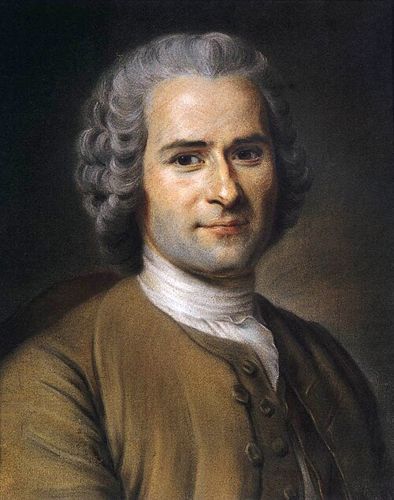
1712 Geneva – 1778 Ermenonville · Republic of Geneva; worked in France
Who they were
A watchmaker's son whose mother died days after he was born. He ran away from his engraving apprenticeship at sixteen, taught himself music and philosophy, and reached Paris in 1742. His essay prizes made him famous; his books Émile and The Social Contract were condemned and publicly burned in Paris and Geneva in 1762, and he spent his last years moving between refuges.
What they found or built
The Discourse on the Sciences and Arts (1750) argued that progress in learning had corrupted morals rather than improved them — the paradox that made his name overnight.
The Discourse on the Origin of Inequality (1755) held that people are naturally good and that society, property and law manufactured inequality.
Émile (1762) rebuilt education around the child's own development: learn from experience and things before books and rules.
The Social Contract (1762) argued that sovereignty belongs to the people and that legitimate law expresses the general will — what citizens want for the common good, not the sum of private interests.
The Confessions (published after his death, 1782–1789) told his whole life, faults included, and effectively invented the modern autobiography.
Why it mattered
The general will and popular sovereignty gave the French Revolution its vocabulary. Robespierre read him as a disciple; in 1794 the Revolution moved his remains to the Panthéon as a secular saint.
Émile founded child-centred education — the line runs through Pestalozzi and Fröbel to Montessori.
His defence of feeling, nature and solitude fed straight into Romanticism.
In their own words
“Man is born free, and everywhere he is in chains.”
Sayings we left out
He never wrote 'noble savage' — the phrase belongs to other writers and is one of the commonest misattributions to him.
His Confessions records that he placed his five children in a foundling hospital, a fact always read against his writing on education.