Legendary
Vincent van Gogh
Painted The Starry Night and Sunflowers in a decade-long career, and wrote hundreds of letters about how he did it.
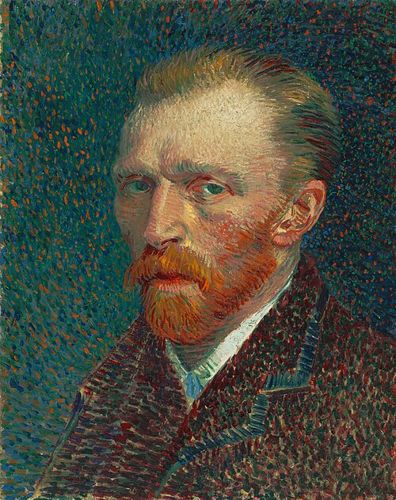
1853 Zundert – 1890 Auvers-sur-Oise · Netherlands, working mostly in France
Who they were
A Dutch pastor's son who was an art dealer, a teacher and a lay preacher before he decided at 27 to become an artist. He taught himself, was supported by his younger brother Theo, and made more than 2,000 works, about 860 of them oil paintings, in roughly ten years.
What they found or built
His early Dutch work is dark and earthy; The Potato Eaters (1885) shows peasants eating by lamplight with the hands that dug the potatoes.
In Paris (1886–1888) he met the Impressionists and the pointillists, and his palette turned to pure, bright colour.
In Arles (1888–1889) he painted the Sunflowers series, The Yellow House and The Bedroom. In December 1888, after a quarrel with Paul Gauguin, he cut off part of his own ear.
In the asylum at Saint-Rémy he painted The Starry Night (June 1889) from the view outside his window. He died in Auvers-sur-Oise in July 1890, aged 37, of a gunshot wound.
Why it mattered
He used colour and brushstroke to carry feeling, not just to copy what was there. That idea led straight to Expressionism and Fauvism and much of modern art.
His letters, more than 800 of which survive, are one of the best records any artist has left of how a picture is thought out and made.
Sayings we left out
The story that he sold only one painting in his life is a simplification: The Red Vineyard is the one documented sale of a painting, but he also sold and traded drawings and other works.
His death is usually accepted as suicide; a 2011 biography argued it may have been an accidental shooting by someone else, which most scholars do not accept.