Physics & Mathematics
Josiah Willard Gibbs
Founded chemical thermodynamics, gave physics its vector notation and named statistical mechanics.
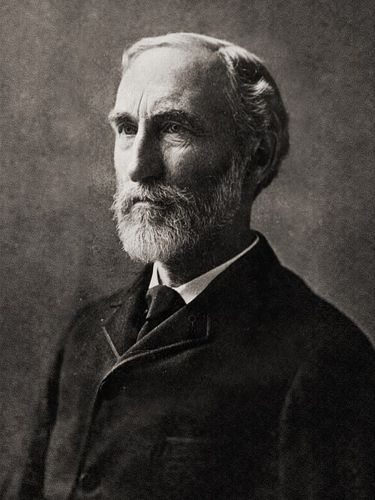
1839 New Haven – 1903 New Haven · United States
Who they were
A quiet Yale professor who rarely left New Haven. In 1863 he received the first American doctorate in engineering, then spent his career publishing in a small local journal, which is why Europe was slow to notice that one of the great minds of the century was writing there.
What they found or built
In On the Equilibrium of Heterogeneous Substances (1875–1878) he worked out when a chemical reaction or a change of phase will happen on its own. The answer is a single quantity now called the Gibbs free energy, G = H − TS. He also introduced the chemical potential and the phase rule, which counts how many phases (ice, water, steam) can coexist.
For his students he wrote Elements of Vector Analysis (privately printed, 1881 and 1884). The dot product a · b and cross product a × b, written in the notation every physics student now uses, come from Gibbs and, independently, from Oliver Heaviside. A vector is simply an arrow measured along Descartes's axes.
His last book, Elementary Principles in Statistical Mechanics (1902), named the field and described ensembles: imagine many copies of a system and average over them. He also explained the overshoot of Fourier series at a jump, now called the Gibbs phenomenon.
Why it mattered
Every chemist who asks whether a reaction will go, every battery and fuel-cell designer, and every materials scientist reading a phase diagram uses Gibbs's free energy. Every physicist writing Maxwell's equations as four short lines uses his vectors. Statistical mechanics, in his form, carried straight into quantum theory.
James Clerk Maxwell was so struck by Gibbs's surfaces for water that he sculpted one in clay and sent Gibbs a plaster cast.
Sayings we left out
“Mathematics is a language” is often credited to Gibbs, as a remark at a Yale faculty meeting. It comes to us second-hand, so we label it attributed.
Einstein is often quoted calling Gibbs “the greatest mind in American history”. We could not trace this to a primary source, so it is left out.
Equations and key ideas
- Gibbs free energy
- Chemical potential
- The phase rule
- Vector analysis
- Statistical ensembles
- The Gibbs phenomenon