Physics & Mathematics
René Descartes
Wrote “I think, therefore I am” and, in the same book, gave mathematics the x–y coordinate plane.
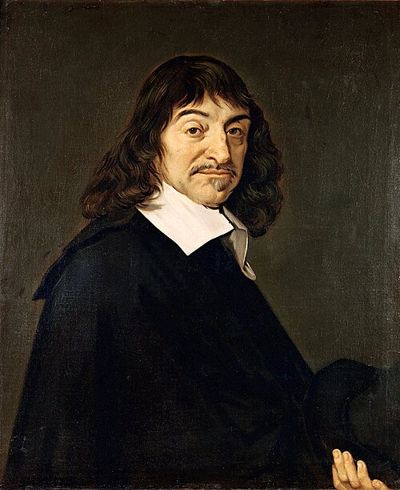
1596 La Haye en Touraine – 1650 Stockholm · France, working mostly in the Dutch Republic
Who they were
A French soldier-scholar who spent most of his working life in the Dutch Republic. He is remembered as the father of modern philosophy, but he thought of himself just as much as a mathematician and natural philosopher: his most famous book was written as a preface to three scientific essays.
What they found or built
In 1637 he published the Discourse on the Method. Part IV holds the line “je pense, donc je suis”: everything can be doubted except the fact that you are doubting, so the thinker must exist. He then tested the method on real problems in three essays bound into the same volume: the Optics, the Meteorology and the Geometry.
La Géométrie showed that a curve can be described by an equation between two lengths, which we now call x and y. A circle, a parabola, any curve becomes a relation between two numbers, so geometry problems can be solved with algebra and algebra can be drawn as pictures. He also gave us the habit of writing unknowns as x, y, z and powers as x², x³, and the rule of signs for counting the positive roots of a polynomial.
In the Meteorology he traced about ten thousand rays through a model raindrop and explained why the rainbow sits at about 42° from the point opposite the Sun.
Why it mattered
Coordinates are the bridge between pictures and numbers. Newton and Leibniz built calculus on them; Gibbs built vector analysis on them; Einstein's spacetime is labelled with them. Every map, GPS fix, screen pixel and orbit drawn on this site is a pair or triple of Cartesian numbers.
Descartes shows that the philosopher and the mathematician can be the same person asking the same question: what can I know for certain, and how do I build from it? His answer in both fields was to start from something undoubtable and proceed in small, clear steps.
In their own words
“Je pense, donc je suis. (I think, therefore I am.)”
“Ego cogito, ergo sum.”
Sayings we left out
Descartes's own axes were not the square grid with two perpendicular number lines we draw today; that picture was filled in by later mathematicians such as Frans van Schooten, who translated and expanded La Géométrie. Pierre de Fermat reached the same idea independently at about the same time.
The story that he invented coordinates by watching a fly crawl across his ceiling is a legend with no source in his writings.
Equations and key ideas
- Cogito, ergo sum
- Cartesian coordinates
- Analytic geometry
- Rule of signs
- The rainbow angle