Quantum Computing
Peter Shor
Showed that a quantum computer could break widely used encryption, and that quantum errors can be corrected.
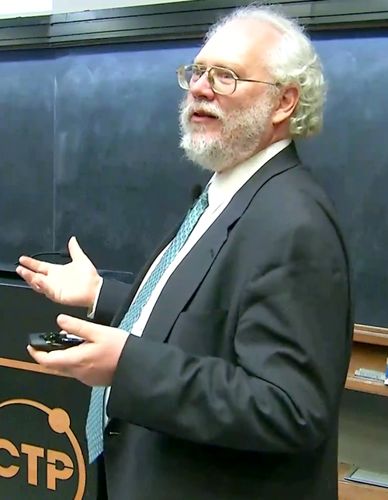
born 1959, New York · United States
Who they were
A mathematician at Bell Labs and then MIT, whose 1994 result brought quantum computing from a curiosity to a matter of national security.
What they found or built
In 1994 he presented an algorithm that factors an integer in a number of steps that grows only polynomially with its size. The best classical methods grow far faster. Since the security of RSA encryption depends on factoring being hard, a large enough quantum computer would break it. The heart of the method is finding the period of a repeating function by quantum interference.
Many experts then argued that quantum computers could never work because errors would swamp them. In 1995 Shor answered with the first quantum error-correcting code, which stores one qubit across nine, and in 1996 he showed how computations can be carried out reliably on noisy hardware, a step toward the threshold theorem that several groups proved in 1996–98. In 2001 a team led by Lieven Vandersypen and Isaac Chuang at IBM ran Shor's algorithm on a 7-qubit molecule and factored 15.
Why it mattered
Shor's algorithm created the field's urgency, and his error-correction work showed it could be more than a dream. It also set off the work on post-quantum cryptography: in August 2024 the United States NIST published its first standards (FIPS 203, 204 and 205) for encryption designed to resist quantum attack. He shared the 2023 Breakthrough Prize in Fundamental Physics.
Equations and key ideas
- Shor's period-finding step: f(x) = aˣ mod N has period r → gcd(a^{r/2} ± 1, N) shares a factor with N
- The threshold theorem: physical error rate p < p_threshold ⇒ logical errors fall as the code grows
- Factoring
- Period finding
- Quantum error correction
- Post-quantum cryptography