Quantum Mechanics
John von Neumann
Gave quantum mechanics its mathematical foundation and defined the measurement problem.
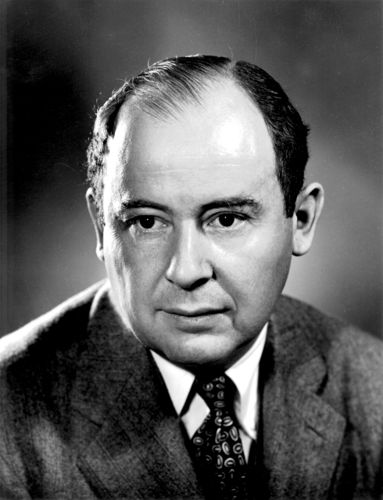
1903 Budapest – 1957 Washington · Hungary, later the United States
Who they were
A Hungarian-born mathematician of astonishing speed, who contributed to set theory, game theory, economics, computing and nuclear weapons design.
What they found or built
His 1932 book Mathematische Grundlagen der Quantenmechanik presented quantum theory as geometry in an abstract space of states (Hilbert space), unifying Heisenberg's and Schrödinger's versions. He introduced the density matrix, which handles mixed and uncertain states, and the entropy that bears his name.
He also analysed measurement carefully. A quantum state evolves smoothly under the Schrödinger equation until someone measures it, when it jumps. Von Neumann showed that the cut between the quantum system and the observer can be placed almost anywhere without changing predictions, which is what makes the 'measurement problem' so awkward.
Why it mattered
Von Neumann's framework is still the standard textbook form of the theory, and it is the mathematical home of quantum information. His 1932 argument that hidden variables are impossible was widely believed for decades, until Grete Hermann (1935) and John Bell (1966) pointed out that it ruled out far less than people thought.
Equations and key ideas
- Hilbert space
- Density matrices
- The measurement problem