Quantum Mechanics
Paul Dirac
Merged quantum mechanics with relativity and predicted antimatter.
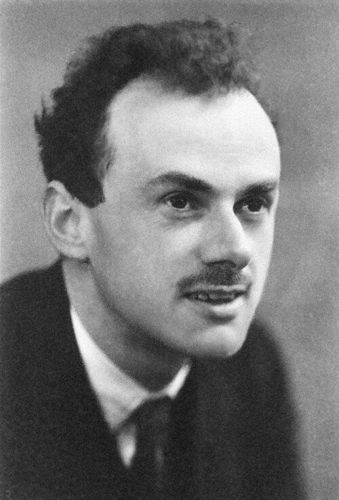
1902 Bristol – 1984 Tallahassee · United Kingdom
Who they were
A famously quiet English physicist, trained first as an electrical engineer. At Cambridge he turned quickly into one of the most formal and elegant theorists of the century, and he held Newton's old Lucasian professorship.
What they found or built
In 1928 he found a relativistic wave equation for the electron. It automatically gave spin, and it also had solutions of negative energy, which after some wrestling he interpreted in 1931 as a new particle with the electron's mass and opposite charge. Carl Anderson found the positron in cosmic rays in 1932.
His textbook The Principles of Quantum Mechanics (1930) set out the abstract language, including the bra-ket notation, that physicists still use. He also anticipated quantum field theory, and in 1931 showed that a single magnetic monopole somewhere in the universe would explain why electric charge comes in fixed units.
Why it mattered
Antimatter was the first prediction of a whole new kind of matter from pure mathematics, a pattern that would repeat through particle physics. Dirac won the 1933 Nobel Prize at thirty-one. His bra-ket notation, |ψ⟩, is the writing system of quantum computing.
In their own words
“The underlying physical laws necessary for the mathematical theory of a large part of physics and the whole of chemistry are thus completely known, and the difficulty is only that the exact application of these laws leads to equations much too complicated to be soluble.”
Equations and key ideas
- Antimatter
- Bra-ket notation
- Relativistic quantum theory