Quantum Mechanics
Wolfgang Pauli
Explained why matter takes up space, and predicted the neutrino.
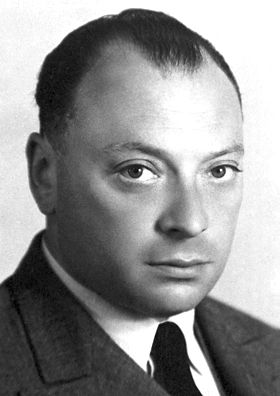
1900 Vienna – 1958 Zürich · Austria, later Switzerland
Who they were
A brilliant and sharply critical Viennese physicist, nicknamed by colleagues 'the conscience of physics' for his fearsome dismissals of sloppy work. Friends joked about the 'Pauli effect', the claim that equipment broke when he walked into a laboratory.
What they found or built
In 1925 he proposed the exclusion principle: no two electrons in an atom can share the same set of quantum numbers. It explains the shell structure of atoms and therefore the entire periodic table. Later work showed it follows from a deeper rule: identical fermions have antisymmetric wave functions.
In 1927 he introduced the matrices (now Pauli matrices) that describe an electron's spin. In December 1930, in a letter addressed to 'Dear radioactive ladies and gentlemen', he suggested a neutral, very light particle to save the conservation of energy in radioactive decay. Enrico Fermi named it the neutrino, and it was detected in 1956 by Clyde Cowan and Frederick Reines.
Why it mattered
Without the exclusion principle atoms would collapse into the lowest state and chemistry would not exist. Pauli's spin matrices are, almost literally, the gates of quantum computing (see the Quantum Computing section). He received the Nobel Prize in 1945, with Einstein among his nominators.
Equations and key ideas
- Spin
- Fermions
- The periodic table
- The neutrino