Quantum Mechanics
Werner Heisenberg
Built the first complete quantum mechanics and discovered the uncertainty principle.
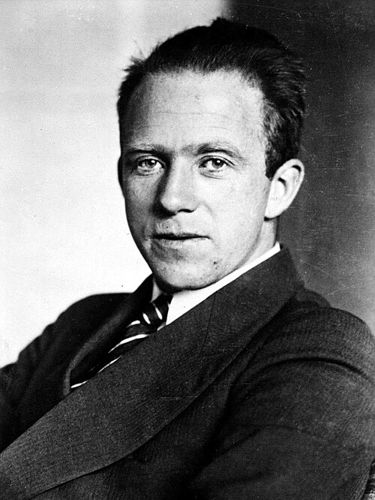
1901 Würzburg – 1976 Munich · Germany
Who they were
A young prodigy from Munich who studied under Sommerfeld and then joined Born in Göttingen and Bohr in Copenhagen. In June 1925, plagued by hay fever, he retreated to the bare North Sea island of Helgoland and there worked out the first workable quantum mechanics.
What they found or built
Heisenberg's matrix mechanics (1925, completed with Born and Pascual Jordan) discarded the picture of electrons orbiting like planets and built the theory only from what could be observed: the frequencies and intensities of light. It used quantities whose product depends on order, which Born recognised as matrices.
In 1927 he showed that position and momentum cannot both be sharp. The uncertainty principle is not a limit of measuring clumsiness; it falls out of the maths. He received the 1932 Nobel Prize.
Why it mattered
Together with Schrödinger's equation, Heisenberg's work is the foundation of every quantum calculation done today. The uncertainty principle also changed philosophy: it ended the idea, held since Newton and Laplace, that a complete knowledge of the present determines the future.
In the Second World War he led the German nuclear energy project. What he intended, and how much he understood, is still debated by historians, and his 1941 meeting with Bohr in occupied Copenhagen remains one of the most argued-over conversations of the century. A fair account has to hold both his scientific greatness and that history.
In their own words
“We have to remember that what we observe is not nature in itself but nature exposed to our method of questioning.”
Equations and key ideas
- Matrix mechanics
- Uncertainty
- Observables