Quantum Mechanics
Niels Bohr
Quantised the atom, then led the interpretation of quantum theory from Copenhagen.
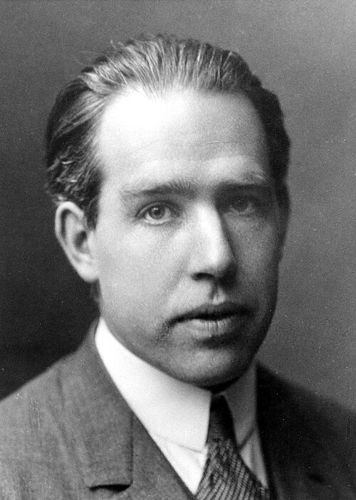
1885 Copenhagen – 1962 Copenhagen · Denmark
Who they were
A Danish physicist and a generous, endlessly talking teacher. His Institute for Theoretical Physics in Copenhagen became the meeting place where most of the founders of quantum mechanics argued their way to the theory.
What they found or built
In 1913 Bohr proposed that an electron in an atom can only occupy certain orbits with fixed energies, and that light is emitted or absorbed when it jumps between them. It explained the spectrum of hydrogen precisely. It was half classical and half quantum, and could not be the final theory, but it worked.
In 1927 he introduced complementarity: the wave and particle descriptions of an electron are both needed, but no single experiment can show both at once. Together with Heisenberg and Born, this became the Copenhagen interpretation. His long public debates with Einstein, at the Solvay conferences of 1927 and 1930 and in the 1935 reply to EPR, are among the great arguments of science.
Why it mattered
Bohr's insistence that physics describes what we can say about measurements, not a world independent of them, shaped how generations of physicists were taught. His critics find it evasive; his defenders find it the only honest reading. Either way it set the terms of the debate.
In 1943 he escaped German-occupied Denmark by boat, and after the war wrote an open letter to the United Nations (1950) urging an open world and international control of atomic weapons. A shared humanity of knowledge was not a slogan for him.
Sayings we left out
'Anyone who is not shocked by quantum theory has not understood it' is attributed to Bohr everywhere, but the version people quote comes from secondary reports, not from a text we can point to. Treat it as an anecdote.
'Stop telling God what to do' as Bohr's reply to Einstein is likewise a story passed on at second hand, not a documented line.
Equations and key ideas
- Complementarity
- The Copenhagen interpretation
- Quantum jumps