Quantum Mechanics
Albert Einstein
Showed that light is made of quanta, then spent his life doubting that quantum theory was the final word.
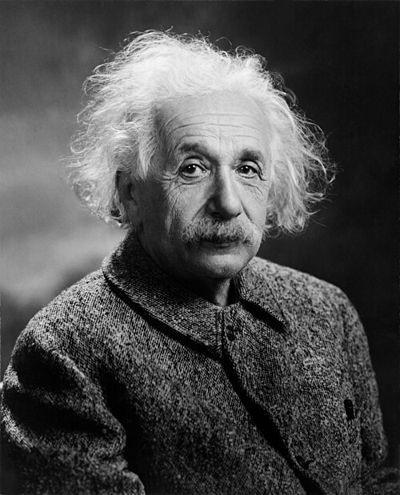
1879 Ulm – 1955 Princeton · Germany, later Switzerland and the United States
Who they were
The physicist everyone knows for relativity, who was also, in 1905, the person who took Planck's idea seriously enough to say it was literally true. His Nobel Prize in 1921 was for the photoelectric effect, not for relativity.
What they found or built
In 1905 he proposed that light consists of discrete quanta (we now call them photons), which explains why light kicks electrons out of a metal only above a certain frequency. In 1907 he showed that quantisation also explains why solids hold heat the way they do. In 1916–17 he described how atoms absorb and emit light, including stimulated emission, the principle behind the laser. In 1924 he turned Satyendra Nath Bose's counting method for photons into a theory of matter.
In 1935, with Boris Podolsky and Nathan Rosen, he published the EPR paper, arguing that quantum mechanics must be incomplete, because it allowed two separated particles to have correlated properties that nothing in the theory could explain locally. He never accepted that the probabilities in quantum theory were the final word.
Why it mattered
Einstein is the founder and the great sceptic of quantum theory at once. His objections were not stubbornness; they were the sharpest questions anyone asked, and they drove Bohr to clarify his view and, decades later, John Bell to turn the EPR argument into an experiment. The answer came out against Einstein's hope for local hidden variables, but his question created the whole modern field of quantum information.
In their own words
“Quantum mechanics is certainly imposing. But an inner voice tells me that it is not yet the real thing. The theory says a lot, but does not really bring us any closer to the secret of the 'old one'. I, at any rate, am convinced that He does not throw dice.”
“spukhafte Fernwirkung (spooky action at a distance)”
Equations and key ideas
- Photons
- Stimulated emission
- The EPR argument
- Local realism
Connected to
Max Planck · Niels Bohr · Satyendra Nath Bose · John Stewart Bell · Erwin Schrödinger