Quantum Mechanics
John Stewart Bell
Proved that no local hidden-variable theory can reproduce quantum mechanics, and turned that into an experiment.
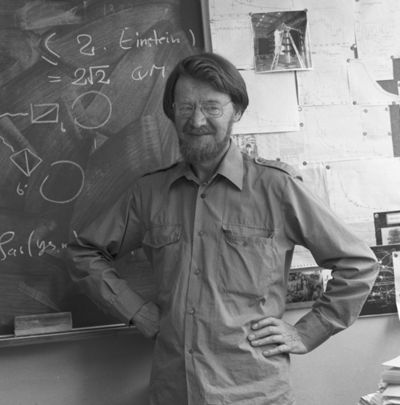
1928 Belfast – 1990 Geneva · Northern Ireland, United Kingdom
Who they were
A Belfast-born particle physicist who worked at CERN designing accelerators and calculating particle physics. Quantum foundations was his night-time passion; he called it his hobby.
What they found or built
In 1964, on leave at Stanford, he published 'On the Einstein Podolsky Rosen Paradox'. He showed that if measurement outcomes were fixed in advance by hidden facts local to each particle, then the correlations between two distant measurements would obey an inequality. Quantum theory predicts violations of that inequality. It was a result you could test.
He also found the flaw in von Neumann's 1932 no-hidden-variables proof (published 1966), and collected his essays in Speakable and Unspeakable in Quantum Mechanics (1987). He pressed physicists to say clearly what they meant by 'measurement'.
Why it mattered
Bell's theorem took a philosophical dispute between Einstein and Bohr and made it an experimental question. The experiments of Clauser, Aspect and Zeilinger, and the loophole-free tests of 2015, came down against local hidden variables. The nature of reality, in this narrow sense, was settled by a laboratory result. Bell died suddenly of a stroke in 1990, aged 62, and never saw the prize his work was widely thought to deserve.
Equations and key ideas
- The Bell (CHSH) inequality: |S| ≤ 2 classically, up to 2√2 in quantum theory
- An entangled pair (a Bell state): |Φ⁺⟩ = (|00⟩ + |11⟩) / √2
- Bell's theorem
- Non-locality
- Hidden variables
Connected to
Albert Einstein · David Bohm · John Clauser, Alain Aspect and Anton Zeilinger · John von Neumann