Quantum Mechanics
Satyendra Nath Bose
Found the correct way to count photons, and with Einstein founded Bose–Einstein statistics.
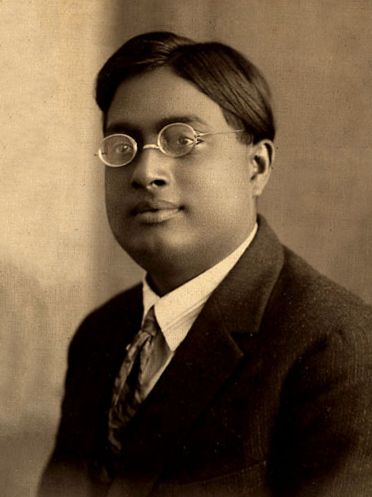
1894 Calcutta – 1974 Calcutta · India
Who they were
A physicist at the University of Dhaka, with no doctorate, who in 1924 sent a four-page paper to Einstein after journals ignored it. A gifted teacher, he also loved music, languages and the Bengali literary world.
What they found or built
Bose derived Planck's black-body law without borrowing any classical argument, by treating photons as identical particles and counting arrangements in a new way: swapping two identical photons gives nothing new. Einstein recognised the importance, translated the paper into German himself and had it published. He then extended the idea to atoms.
Particles that obey this counting rule are now called bosons. Cooled enough, they can all fall into the lowest state together: a Bose–Einstein condensate, predicted by Einstein in 1924–25 and first made in a laboratory in 1995 by Eric Cornell, Carl Wieman and Wolfgang Ketterle (Nobel Prize 2001).
Why it mattered
Bose's counting is half of the quantum world's two families of particles: bosons, which like to bunch (light, lasers, superfluids), and fermions, which refuse to share (electrons, see Pauli). Bose never received a Nobel Prize; the particle family carries his name instead.
Equations and key ideas
- Bosons
- Identical particles
- Bose–Einstein condensate