Quantum Mechanics
Erwin Schrödinger
Wrote the wave equation of quantum mechanics and coined the term 'entanglement'.
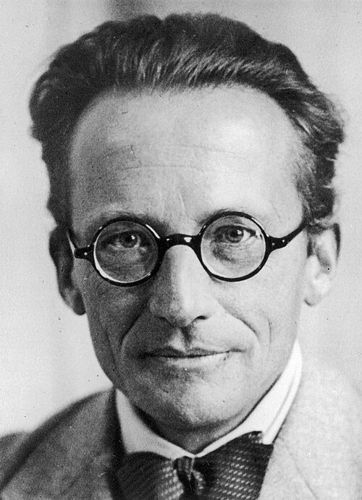
1887 Vienna – 1961 Vienna · Austria
Who they were
A restless, wide-reading Viennese physicist who moved between Zürich, Berlin, Oxford, Graz and, after 1939, Dublin. Over Christmas 1925 he went to a Swiss mountain resort and came back with the equation that carries his name.
What they found or built
In 1926 he published a series of papers presenting a wave equation for matter, building on de Broglie. It reproduced the hydrogen spectrum in the language of ordinary differential equations that physicists already knew, and he soon showed it equivalent to Heisenberg's matrices. He hoped it described real waves; Born's interpretation showed it did not.
In 1935, in response to EPR, he introduced the word Verschränkung, 'entanglement', and the thought experiment of the cat: a cat in a box whose fate hangs on a single quantum event, to show how absurd it was to treat superposition as a literal description of large things. He meant it as a criticism; today it is the best-known picture of quantum strangeness.
In Dublin he gave the lectures published as What Is Life? (1944), which asked how a molecule could carry heredity and inspired many young scientists to turn to biology.
Why it mattered
Most working physicists and chemists spend their days solving some version of the Schrödinger equation. Entanglement, a word he introduced almost in passing, became the central resource of quantum information. He shared the 1933 Nobel Prize with Dirac. He left Germany in 1933 in opposition to the Nazis, and his unconventional private life cost him positions along the way.
Equations and key ideas
- The wave function
- Entanglement
- Schrödinger's cat
Connected to
Louis de Broglie · Max Born · Albert Einstein · Wojciech Zurek