Quantum Mechanics
Max Born
Showed that the wave function gives probabilities.
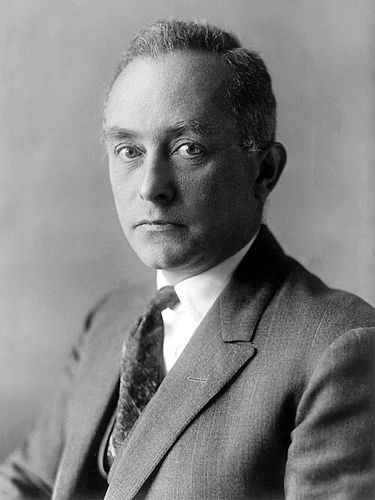
1882 Breslau (now Wrocław) – 1970 Göttingen · Germany, later Britain
Who they were
A mathematically gifted physicist who ran the Göttingen institute that trained a generation of quantum pioneers. When Heisenberg showed him his Helgoland calculation, Born realised the strange multiplication rule was matrix multiplication, which he had learned as a student.
What they found or built
With Heisenberg and Jordan he built matrix mechanics. In 1926, studying electron collisions, he saw how to read Schrödinger's wave function: its squared size is the probability of finding the particle. The footnote where he first said it is among the most consequential in physics.
He also co-developed the Born–Oppenheimer approximation, which lets chemists treat nuclei as fixed while electrons move, the basis of nearly all quantum chemistry.
Why it mattered
The Born rule is the single bridge between quantum maths and what a laboratory records. Everything else, such as measurement, superposition and chance, hangs on it. Born received the Nobel Prize only in 1954, nearly three decades after the work. Dismissed from Göttingen in 1933 for his Jewish background, he found refuge in Cambridge and Edinburgh, and in 1957 he signed the Göttingen Manifesto against arming West Germany with nuclear weapons.
Equations and key ideas
- The probability interpretation
- Matrix mechanics
Connected to
Werner Heisenberg · Erwin Schrödinger · Albert Einstein · Niels Bohr