Quantum Mechanics
Louis de Broglie
Proposed that matter has a wavelength.
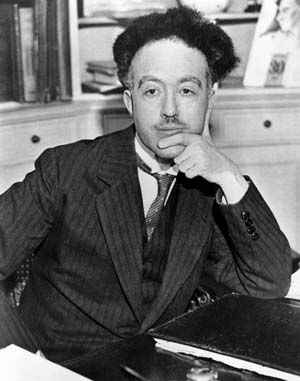
1892 Dieppe – 1987 Louveciennes · France
Who they were
A French aristocrat, born into the ducal house of Broglie, who began in history and turned to physics after the First World War, partly through his brother Maurice's X-ray laboratory.
What they found or built
In his 1924 doctoral thesis he argued that if light can behave as a particle, then particles such as electrons must behave as waves, with wavelength λ = h/p. It was a bold step with almost no experimental support. His examiner Paul Langevin sent a copy to Einstein, who approved. In 1927 Clinton Davisson and Lester Germer in the United States, and G. P. Thomson in Scotland, saw electrons diffract off crystals just as waves should.
At the 1927 Solvay conference he presented a 'pilot wave' picture in which a real particle is guided by a real wave. It was received coolly and he dropped it; David Bohm revived it in 1952.
Why it mattered
De Broglie's wave of matter gave Schrödinger his starting point and gave us electron microscopes, which see with the short wavelength of fast electrons. His 1929 Nobel Prize was awarded for a thesis written five years earlier.
Equations and key ideas
- Matter waves
- Wave–particle duality
- Pilot-wave theory