The Sun at the centre
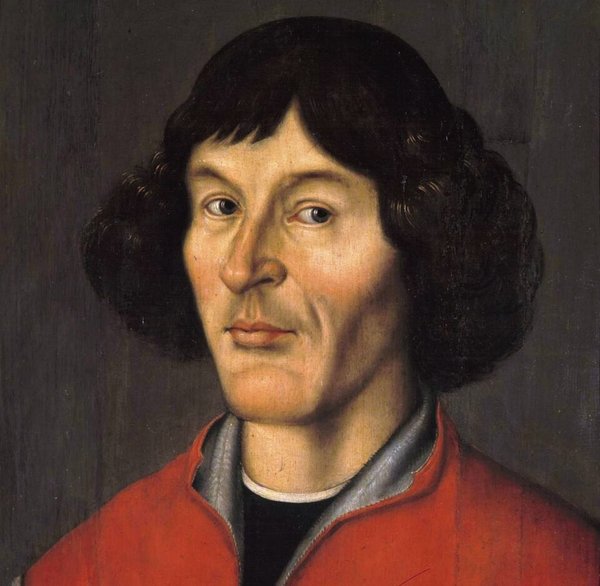
Nicolaus Copernicus
1473 – 1543 · Toruń → Frombork
A church canon, doctor and administrator who moved the Earth: it spins once a day and goes round the Sun once a year, like every other planet.
Portrait: unknown artist, c. 1580, Toruń Town Hall. Public domain, via Wikimedia Commons

- 1543De revolutionibus
- 6planets ordered by distance
- 24 hEarth spins
- 1 yrEarth orbits
Why planets loop backwards
Every so often Mars slows, stops, drifts backwards against the stars for about two months, then carries on. Ptolemy explained it by putting each planet on a small circle riding a bigger one. Copernicus saw a simpler reason: we are on a faster, inner lane and we are overtaking it. Flip the view below.
1.524 AU
orbit
780 d
laps us every
forwards
moving
- S: the synodic period: years between two overtakes, when the loop happens
- P: the planet's own year, in Earth years (Mars: 1.88)
- 1: the Earth's year, one lap per year
For Mars that gives 2.1 years, about 780 days between loops.
“In medio vero omnium residet Sol. (At rest in the middle of everything is the Sun.)”
He measured the solar system
Put the Sun at the centre and the sizes of the orbits fall out of geometry. For Venus: at its greatest angle from the Sun, the line from Earth just grazes its orbit, so a right angle sits at Venus.
- a: the planet's distance from the Sun, with Earth's set to 1
- ε max: its greatest angle away from the Sun seen from Earth: 46° for Venus, so a = 0.72
- Mercury0.376today 0.387
- Venus0.719today 0.723
- Mars1.52today 1.524
- Jupiter5.219today 5.203
- Saturn9.174today 9.537
Distances from the Sun in Earth–Sun units: Copernicus's value, and today's.
Copernicus on money
He also ran the finances of the Warmia chapter, and in 1526 finished a treatise on coinage. Debased coins, he argued, drive out good ones, which people hoard or melt; and the more coin in circulation, the less each buys. The first idea is now called Gresham's law (sometimes Copernicus–Gresham); the second is an early form of the quantity theory of money, the argument still running under quantitative easing.
What he got wrong
He kept perfect circles, so he still needed small extra circles to match the sky, and his tables were not much more accurate than Ptolemy's. Kepler's ellipses (1609) fixed that, Galileo's telescope gave the evidence, and Newton gave the reason.
Timeline
19 Feb 1473
Born in Toruń, Royal Prussia, to a merchant family.
1491 – 95
University of Kraków: mathematics and astronomy. His uncle, later Prince-Bishop of Warmia, pays his way.
1496 – 1503
Italy: canon law at Bologna, where he observes with the astronomer Domenico Maria Novara; medicine at Padua; doctorate in canon law at Ferrara, 1503.
9 Mar 1497
Watches the Moon pass in front of the star Aldebaran from Bologna.
c. 1510 – 14
The Commentariolus, a short handwritten outline of a Sun-centred system, circulates among friends.
1517 – 26
Writes on coinage for the Prussian estates; the 1526 Monetae cudendae ratio argues that debased coins drive good ones out of use.
1539
Georg Joachim Rheticus, a young Lutheran mathematician, arrives at Frombork and becomes his only student.
1540
Rheticus publishes the Narratio prima, the first printed account of the theory.
1543
De revolutionibus orbium coelestium printed in Nuremberg, with an unsigned preface by Andreas Osiander calling it a mere calculating device.
24 May 1543
Dies at Frombork.
5 Mar 1616
The Catholic Church suspends De revolutionibus 'until corrected'.
22 May 2010
Reburied in Frombork Cathedral after his remains were identified by DNA matched to hairs in one of his books.
Next: Galileo, who turned a telescope on the sky and proved him right.
Sources
- N. Copernicus, De revolutionibus orbium coelestium (Nuremberg, 1543), Book I
- N. Copernicus, Monetae cudendae ratio (1526)
- Edward Rosen (tr.), Nicholas Copernicus: On the Revolutions (1978)
- Owen Gingerich, The Book Nobody Read (2004)
- W. Bogdanowicz et al., “Genetic identification of putative remains of the famous astronomer Nicolaus Copernicus”, PNAS 106 (2009) 12279–12282