Physicist · Mathematician
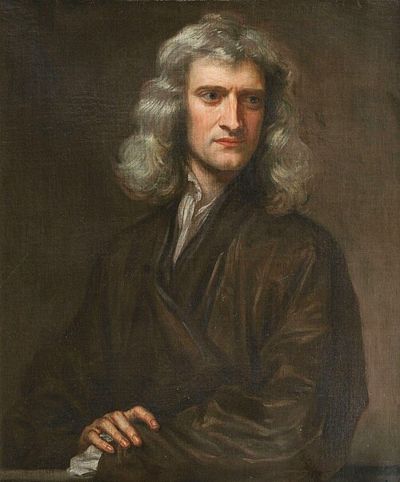
Isaac Newton
1643 – 1727 · Woolsthorpe, Lincolnshire → London
He split white light into its colours, wrote down the laws of motion and gravity, and laid the foundation the rest of physics stands on.
- 1666prism & colour
- 1668reflecting telescope
- 1687Principia
- 1704Opticks
The prism
He let sunlight through a small hole in a window shutter and into a glass prism. The patch on the far wall was not a white circle but a long band of colour. He named seven: red, orange, yellow, green, blue, indigo, violet.
Glass bends each colour by a slightly different amount, violet most and red least. In his experimentum crucis, the crucial experiment, he let one colour through a hole in a board and into a second prism. It bent again but stayed the same colour. The colours were in the light all along; the prism only sorts them.
“Light it self is a Heterogeneous mixture of differently refrangible Rays.”
- n: how strongly a material slows light: air about 1, glass about 1.5
- θ: the angle of the ray to the line straight through the surface
- n(colour): in glass n is a little larger for violet than for red, so violet bends more
Motion and gravity
- F: the push or pull on an object
- m: its mass, how hard it is to get moving
- a: how quickly its speed or direction changes
- F: the gravitational pull between two bodies
- m₁, m₂: their masses
- r: the distance between their centres; double it and the pull drops to a quarter
- G: Newton's constant, 6.674 × 10⁻¹¹ N m² kg⁻²
One law for a falling apple and for the Moon in its orbit.
Built on Newton
Every theory after him either extends his or marks where it stops working.
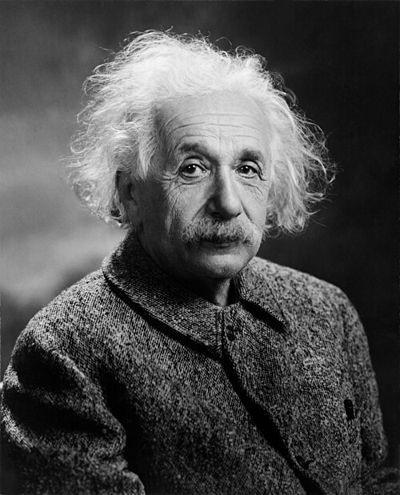
Albert Einstein
1879 – 1955
Relativity (1905, 1915) replaced Newton's absolute space and time. At everyday speeds and in weak gravity, Einstein's equations give back Newton's exactly. He also showed that light arrives in packets, photons.
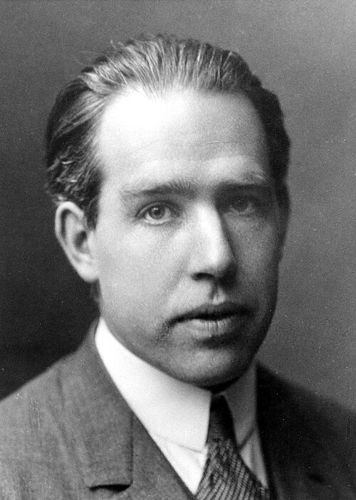
Niels Bohr
1885 – 1962
Newton's prism became spectroscopy. In 1913 Bohr explained why hydrogen glows in sharp coloured lines: the electron jumps between fixed orbits, and each jump gives out one colour.
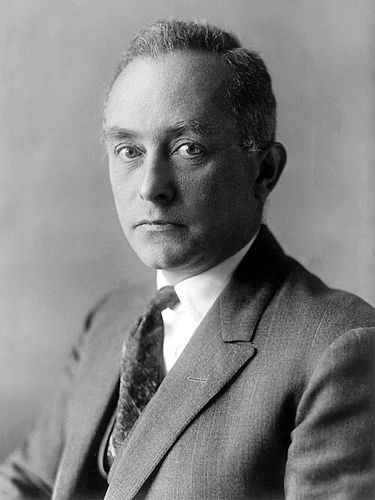
Max Born
1882 – 1970
Gave the quantum wave its meaning in 1926: its square is the probability of finding the particle there. Heisenberg was his assistant at Göttingen; Oppenheimer was his doctoral student.
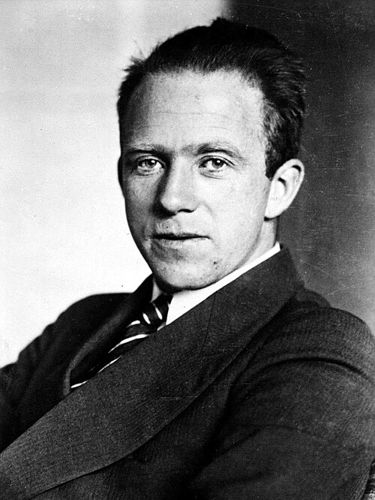
Werner Heisenberg
1901 – 1976
Newton gives every particle an exact position and speed. In 1925 Heisenberg wrote a new mechanics for the atom, and in 1927 showed that position and momentum cannot both be known exactly.
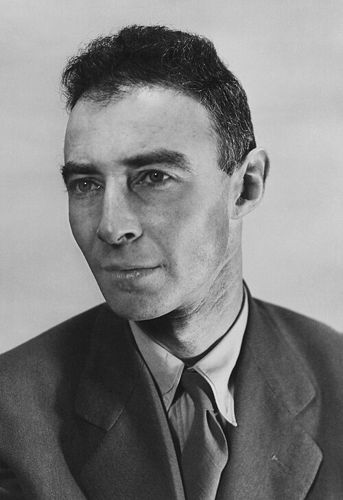
J. Robert Oppenheimer
1904 – 1967
With Born in 1927 he split a molecule into slow, almost Newtonian nuclei and fast quantum electrons. In 1939, with Hartland Snyder, he showed that a heavy enough star collapses without end. He directed Los Alamos in the Manhattan Project.
“If I have seen further it is by standing on the shoulders of Giants.”