The first to look
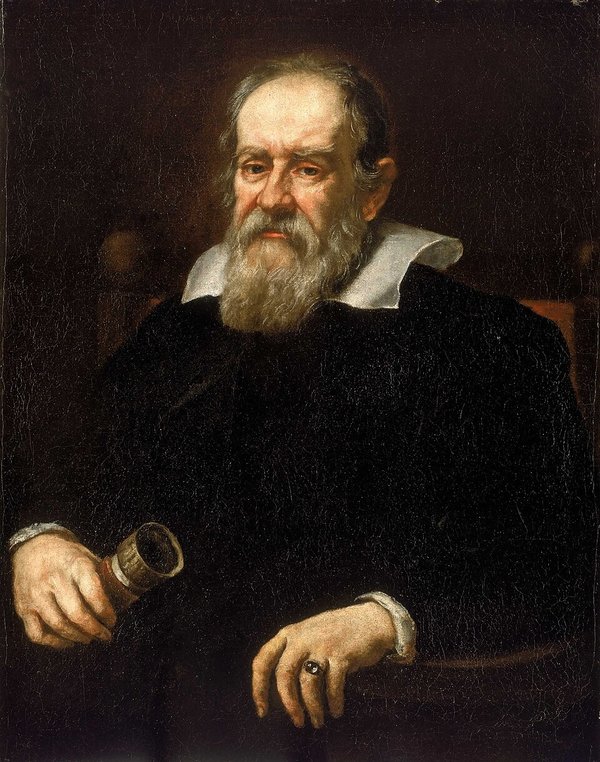
Galileo Galilei
1564 – 1642 · Pisa → Padua → Florence
He pointed a telescope at the sky, timed balls rolling down ramps, and insisted that what you measure outranks what you are told.
Portrait: Justus Sustermans, 1636–40, oil. Public domain, via Wikimedia Commons

- 20×his best telescope
- 4moons of Jupiter
- 1610Starry Messenger
- t²law of fall
Moons round Jupiter
If everything circled the Earth, nothing could circle Jupiter. Galileo drew the little stars every clear night and watched them shuffle from side to side. Scrub through the nights below.
7 Jan 1610
night
3
east
1
west
The phases of Venus
The decisive one. A full set of phases, with Venus small when full and large as a crescent, is only possible if Venus goes round the Sun.
100 %
lit
0
day of 584
Falling: time squared
A falling ball is too fast to time with a water clock, so he slowed it down on a ramp. In equal beats it covers distances in the ratio 1 : 3 : 5 : 7, and weight makes no difference, against two thousand years of Aristotle.
8°
ramp
1 · 3 · 5 · 7 · 9
units per beat
- d: distance fallen from rest
- g: the pull of gravity, 9.8 m/s² at the Earth's surface (smaller along a ramp)
- t: time since release: double it and the distance is four times as far
“It is written in the language of mathematics, and its characters are triangles, circles, and other geometric figures.”
The trial
The 1632 Dialogue made the case for the moving Earth and put the Pope's favourite argument in the mouth of a character called Simplicio. In 1633 he was made to kneel and abjure, and lived his last nine years under house arrest, where he wrote his greatest book on motion. “Eppur si muove” (“and yet it moves”) is attributed: it first appears in print in 1757.
His evidence was strong but not yet proof: the Earth's motion was only shown directly by stellar aberration (Bradley, 1729), stellar parallax (Bessel, 1838) and Foucault's pendulum (1851).
Timeline
15 Feb 1564
Born in Pisa, son of the musician Vincenzo Galilei.
1589
Professor of mathematics at Pisa.
1592
Moves to Padua, in the Venetian Republic, for eighteen years he later called his best.
Aug 1609
Hearing of a Dutch spyglass, builds his own and shows an 8× telescope to the Venetian Senate.
7 Jan 1610
Sees three small 'stars' in a line beside Jupiter; on 13 January a fourth. Within days he sees them moving round it.
Mar 1610
Sidereus Nuncius (The Starry Messenger): mountains on the Moon, countless stars in the Milky Way, Jupiter's moons, named the Medicean Stars.
1610
Chief mathematician and philosopher to Cosimo II de' Medici in Florence. By December he is watching Venus go through phases.
1613
Letters on Sunspots: the Sun has spots and turns.
Feb 1616
Cardinal Bellarmine tells him not to hold or defend the Earth's motion.
1623
Il Saggiatore (The Assayer).
1632
Dialogue Concerning the Two Chief World Systems, written in Italian for everyone.
22 Jun 1633
Tried by the Roman Inquisition, made to abjure, sentenced to house arrest for life at Arcetri.
1638
Two New Sciences, smuggled out and printed in Leiden: the science of materials and of motion.
8 Jan 1642
Dies at Arcetri, blind. Newton is born that year (25 Dec, old calendar).
31 Oct 1992
Pope John Paul II accepts a commission's finding that the judges erred.
See how his instrument grew into Webb on Telescopes, and the theory he defended on Copernicus.
Sources
- G. Galilei, Sidereus Nuncius (Venice, 1610), tr. Albert Van Helden (1989)
- G. Galilei, Il Saggiatore (1623), in Stillman Drake, Discoveries and Opinions of Galileo (1957)
- G. Galilei, Discorsi e dimostrazioni matematiche intorno a due nuove scienze (Leiden, 1638)
- Stillman Drake, Galileo at Work (1978)
- Museo Galileo, Florence: Galileo's telescopes (inv. 2427, 2428)
- Giuseppe Baretti, The Italian Library (London, 1757), on “Eppur si muove”