Chemist · Natural philosopher
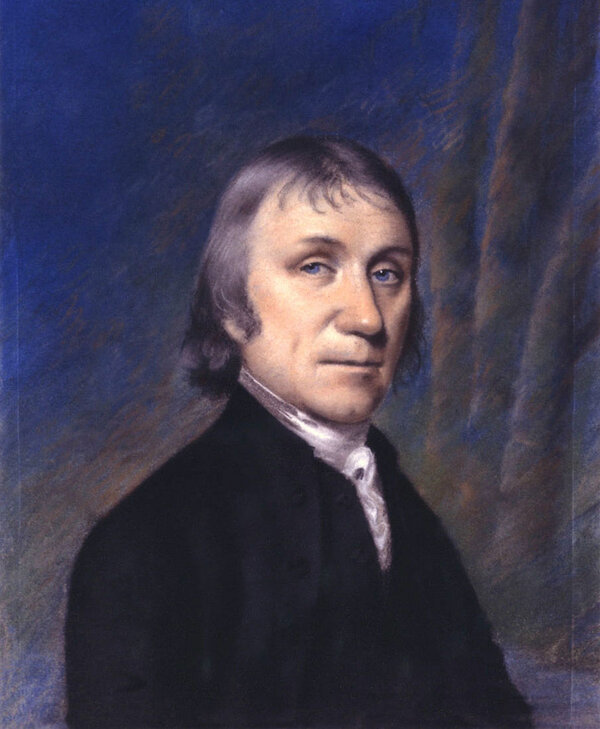
Joseph Priestley
1733 – 1804 · Birstall, Yorkshire → Northumberland, Pennsylvania
A self-taught minister who found oxygen, made the first fizzy water and showed that green plants remake the air we breathe.
Portrait: Ellen Sharples, c. 1794–97, pastel. Public domain, via Wikimedia Commons

- 1767soda water
- 1771plants restore air
- 1774oxygen
- 150+books & pamphlets
The mouse and the mint
In a sealed jar a candle soon goes out and a mouse soon faints. Priestley found that a living sprig of mint, left in that spent air, put it right.
21.0 %
oxygen
0.0 %
carbon dioxide
0 min
elapsed
air good
jar
“On the 17th of August, 1771, I put a sprig of mint into a quantity of air, in which a wax candle had burned out, and found that, on the 27th of the same month, another candle burned perfectly well in it.”
He had seen the first half of photosynthesis. Jan Ingenhousz showed in 1779 that the plant only does it in light, which is why the sim stops at night. The full reaction:
- CO₂: the carbon dioxide the candle and the mouse breathed out
- H₂O: water the plant draws up
- C₆H₁₂O₆: sugar the plant keeps as food
- O₂: the oxygen it gives back, the good air Priestley measured
1 August 1774: oxygen
At Bowood he turned a 12-inch burning lens on red mercury calx sealed in a glass vessel standing in mercury. A gas came off. A candle in it blazed; a mouse lived far longer in it than in ordinary air.
20 °C
calx
0 mL
new air
×1
flame
“Hitherto only two mice and myself have had the privilege of breathing it.”
- HgO: mercury calx, the red powder
- Hg: the beads of liquid mercury left behind
- O₂: the new air, about 21 % of ordinary air, so a flame in pure oxygen burns nearly five times as hard
The first soda water
In Leeds his chapel stood next to a brewery. He hung bowls of water over the fermenting vats, poured the water back and forth, and it came out sparkling. In 1772 he published how to make it at home; in 1783 Johann Jacob Schweppe began selling it in Geneva.
1.0 atm
CO₂ pressure
2.8 g/L
dissolved
- c: how much CO₂ the water holds
- k_H: a constant for CO₂ in water: about 2.8 g per litre per atmosphere when cold
- p: the pressure of CO₂ above the water
William Henry wrote this law down in 1803; Priestley worked at one atmosphere.
The airs he named
- O₂oxygenDephlogisticated air
- NOnitric oxideNitrous air
- N₂Olaughing gasDiminished nitrous air
- NH₃ammoniaAlkaline air
- HClhydrogen chlorideMarine acid air
- SO₂sulfur dioxideVitriolic acid air
- CO₂ + H₂Osoda waterFixed air in water
Electricity, 1767
Franklin noticed that a cork inside a charged metal cup feels no force. Priestley saw what that meant: it only works if electric force falls off with the square of distance, like gravity. Coulomb measured it in 1785.
- F: the push or pull between two charges
- q₁, q₂: the two charges
- r: the distance between them: double it and the force drops to a quarter
- k: a fixed constant, 8.99 × 10⁹ N·m²/C²
Where he was wrong
He explained his gas with phlogiston, the old idea that burning releases a substance. Lavoisier, after hearing of the experiment, showed that burning takes oxygen in, named it in 1777, and founded modern chemistry. Carl Wilhelm Scheele in Sweden had made oxygen around 1771 but published only in 1777. Priestley never gave phlogiston up, and wrote a defence of it in 1800.
A free mind
He wrote on grammar, history, education, theology and politics as well as chemistry, argued for religious freedom and the American and French revolutions, and paid for it: the 1791 Birmingham riots burned his home and his laboratory. He rebuilt in Pennsylvania. Jefferson called him one of the few lives precious to mankind.
Timeline
13 Mar 1733
Born at Fieldhead, Birstall, near Leeds, the eldest son of a cloth dresser. His mother dies when he is six; an aunt raises him.
1752 – 55
Daventry Academy. As a dissenter he is barred from Oxford and Cambridge, so he teaches himself languages, maths and natural philosophy.
1761
Tutor in languages and literature at Warrington Academy.
1765 – 66
Meets Benjamin Franklin in London. Elected a Fellow of the Royal Society.
1767
The History and Present State of Electricity. Minister at Mill Hill Chapel, Leeds, next door to a brewery, where he starts studying the gas over the vats.
1770
Notes that a gum from the Indies rubs out pencil marks. The name rubber follows.
1771 – 72
The mouse and the mint. Publishes Directions for Impregnating Water with Fixed Air and Observations on Different Kinds of Air.
1773
Copley Medal, the Royal Society's highest honour. Becomes librarian and companion to the Earl of Shelburne at Bowood House, Wiltshire.
1 Aug 1774
Heats red mercury calx with a burning lens. A candle in the gas burns with a remarkably vigorous flame. In October he describes it to Lavoisier over dinner in Paris.
1775
Names it dephlogisticated air and breathes it himself.
1780
Moves to Birmingham as minister of the New Meeting; joins Watt, Wedgwood, Boulton and Erasmus Darwin in the Lunar Society.
14 Jul 1791
A Church-and-King mob burns his house, library and laboratory at Fair Hill for his support of the French Revolution.
1794
Emigrates to Northumberland, Pennsylvania. Corresponds with Jefferson and Adams.
6 Feb 1804
Dies at Northumberland, still defending phlogiston.
More minds on Thinkers and Become Legendary.
Sources
- J. Priestley, “Observations on Different Kinds of Air”, Philosophical Transactions 62 (1772) 147–264
- J. Priestley, Experiments and Observations on Different Kinds of Air, vol. II (1775)
- J. Priestley, Directions for Impregnating Water with Fixed Air (1772)
- J. Priestley, The History and Present State of Electricity (1767)
- Robert E. Schofield, The Enlightenment of Joseph Priestley (1997) and The Enlightened Joseph Priestley (2004)
- American Chemical Society, National Historic Chemical Landmark: Joseph Priestley and the Discovery of Oxygen (1994)
- T. Jefferson to J. Priestley, 21 March 1801